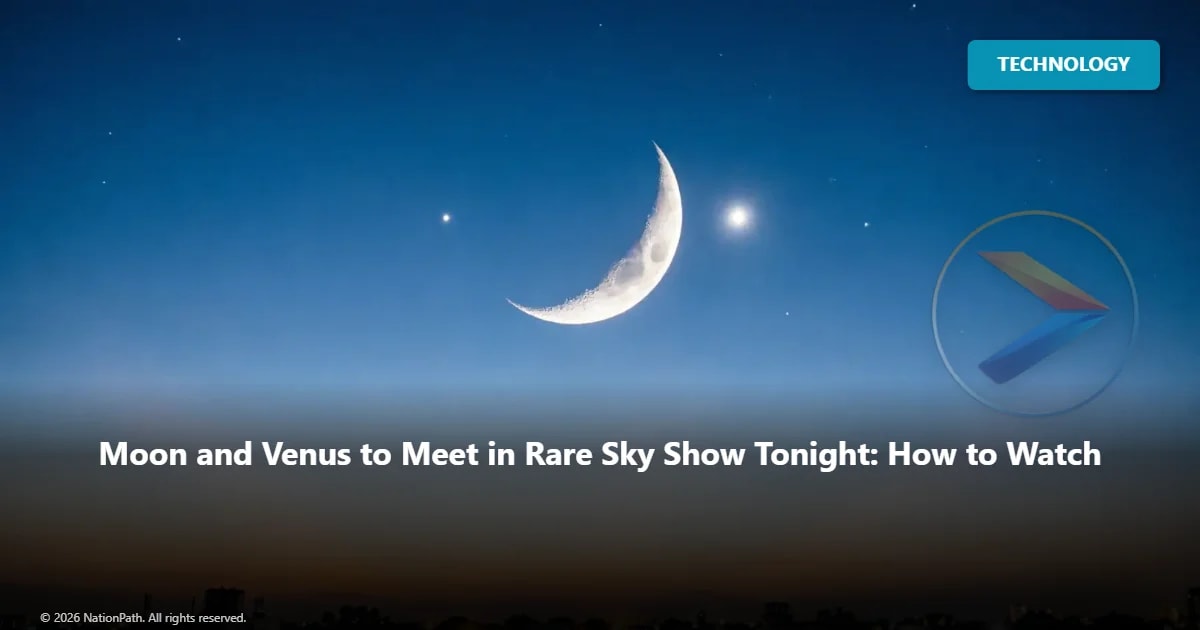

A rare celestial event is set to attract skywatchers on September 14 as the Moon passes close to Venus, creating a striking pairing in the evening sky.
The event is more than a simple Moon-Venus conjunction. The Moon will also pass in front of Venus in a phenomenon known as a lunar occultation, although visibility of the occultation itself will depend on location. Astronomy calendars list September 14 for the Moon-Venus conjunction and Venus occultation.
Editorial Insight
Key Highlights
Important points readers should notice.
Issue/Event: Moon-Venus conjunction and lunar occultation
Location: Visible as a sky event from parts of Asia, with visibility varying by location
Authority/Organisation: Astronomy observatories and astronomical calendars
Action Taken: Skywatchers are advised to observe the western sky around sunset
Impact: Rare and visually striking celestial event for astronomy enthusiasts
For observers in India, the most practical opportunity will be around sunset and shortly afterward, when the thin crescent Moon and brilliant Venus can be sought low in the western sky, provided the horizon is clear. Reports on the event indicate that the pairing should be visually striking even where the actual occultation is not visible.
Venus is currently one of the brightest objects visible in the evening sky, making it considerably easier to identify than most other planets. The National Astronomical Observatory of Japan also lists September 14 as the date when a thin crescent Moon will appear close to Venus in the low western sky after sunset.
The event comes just days after the September 11 New Moon, meaning the Moon will appear as a very slender crescent during this encounter.
Editorial Analysis
Why This Matters
The close pairing gives casual skywatchers an easy opportunity to spot Venus alongside a young crescent Moon, while the occultation adds scientific interest to the event.