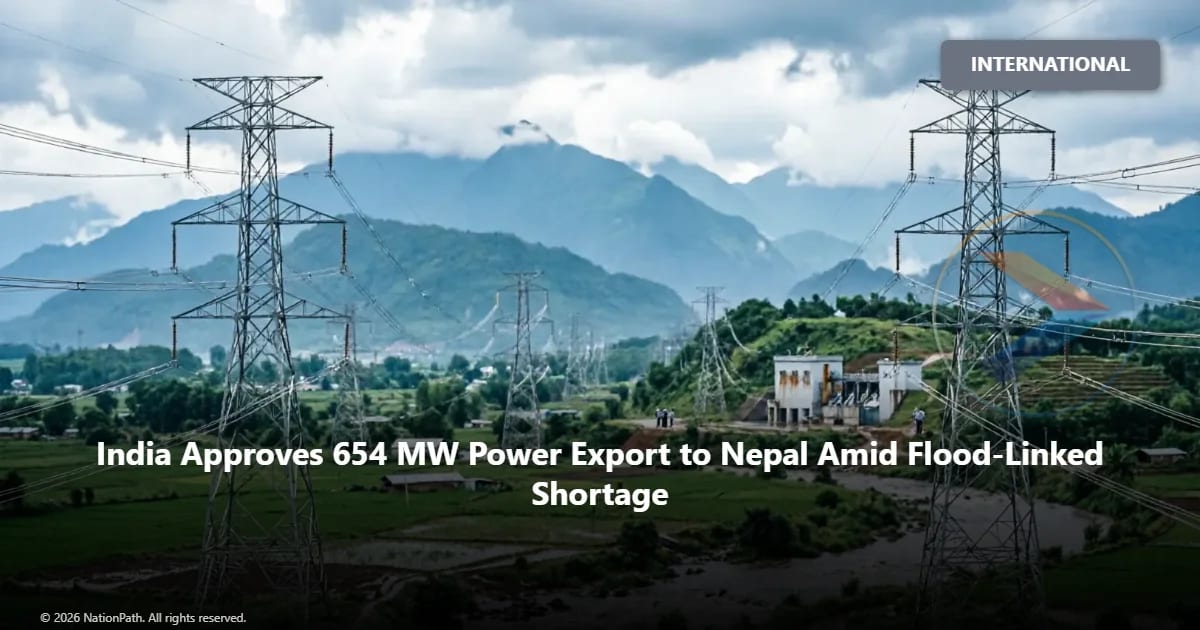

India has approved Nepal's request to import up to 654 megawatts of electricity for 18 hours every day through December 31, 2026, as the neighbouring country faces a power shortage following severe flood-related damage to its hydropower infrastructure.
According to the Ministry of Power, the arrangement covers electricity supply from September 13 through December 31 and is intended to support Nepal's power requirements during the recovery period.
Editorial Insight
Key Highlights
Important points readers should notice.
Issue/Event: India approves additional electricity exports to Nepal
Location: India–Nepal cross-border transmission network
Authority/Organisation: Ministry of Power, Government of India
Action Taken: Approved up to 654 MW of electricity for 18 hours daily until December 31
Impact: Helps Nepal manage electricity shortages after flood-related damage to hydropower infrastructure
Under the approved arrangement, up to 600 MW will be supplied through the Muzaffarpur–Dhalkebar 400 kV transmission line, while another 54 MW will be transmitted through the Tanakpur–Mahendranagar 132 kV line.
The decision follows devastating flash floods in Nepal that damaged several hydropower facilities and disrupted electricity generation. Nepal's power sector has been particularly affected because hydropower forms the backbone of the country's electricity generation.
The additional electricity from India is expected to help Nepal meet domestic demand while damaged generation and transmission infrastructure is being assessed and restored.
Editorial Analysis
Why This Matters
Nepal relies heavily on hydropower for electricity generation, making damage to generating stations and transmission infrastructure particularly disruptive. India's additional supply can help stabilise Nepal's electricity system while damaged projects are repaired. The arrangement also highlights the growing importance of regional power connectivity between the two countries.
The timing of the arrangement also allows Nepal to receive power during daytime and other available periods when India's generation system can accommodate additional exports. The supply arrangement is expected to be reviewed toward the end of the year.
The move represents another significant step in India-Nepal energy cooperation. Cross-border electricity trade has become an increasingly important part of the bilateral relationship, with both countries using their interconnected power networks to manage seasonal variations in generation and demand.
For Nepal, the immediate priority is restoring damaged hydropower infrastructure while maintaining reliable electricity for households, businesses and essential services.
For India, the arrangement demonstrates how cross-border power connectivity can provide support during a major natural disaster while strengthening regional energy cooperation.