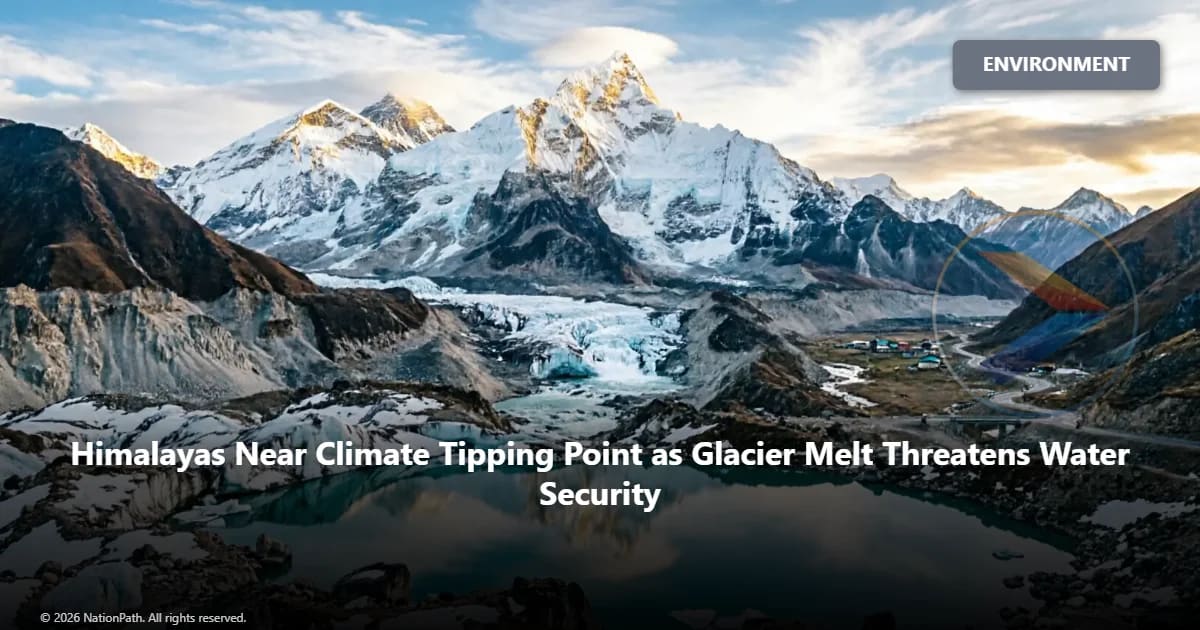

The Himalayas are approaching a critical climate tipping point as glaciers continue to lose ice at an accelerating pace, raising concerns over water security, disaster risks and the livelihoods of millions across South Asia.
A new report warns that Himalayan glaciers are melting faster than they were a decade ago and that the region could reach “peak water” by the middle of this century. Peak water refers to the point at which increasing glacier melt initially boosts river flows before declining ice reserves eventually lead to reduced water availability.
Editorial Insight
Key Highlights
Important points readers should notice.
Issue/Event: Accelerating Himalayan glacier melt and rising climate risks
Location: Hindu Kush Himalaya region, including the Indian Himalayas
Authority/Organisation: Climate researchers, Indian disaster-management and scientific agencies
Action Taken: Increased monitoring, early-warning systems and GLOF preparedness
Impact: Potential pressure on water security, agriculture, hydropower and downstream communities
The warning carries particular significance for India, where Himalayan rivers support agriculture, drinking-water supplies, hydropower and large population centres downstream.
The report also highlights the growing danger from glacial lakes. Nearly 200 high-risk glacial lakes have been identified in the Himalayan region, with 56 in India classified as very high risk. Instability in such lakes can trigger Glacial Lake Outburst Floods (GLOFs), sending sudden volumes of water downstream and threatening communities and infrastructure.
The risks are not limited to future water shortages. Faster glacier retreat can increase the likelihood of floods, landslides and other cascading hazards in mountain regions. Indian scientific programmes have also identified glacier-related hazards including GLOFs, glacier avalanches, debris flows and risks linked to melting permafrost.
Editorial Analysis
Why This Matters
The Himalayas are a major source of freshwater for South Asia. Changes in glacier behaviour can affect not only mountain communities but also agriculture, energy production, cities and industries far downstream. The economic implications are significant because disruptions to water and hydropower can spread across multiple sectors. The latest assessment warns that the consequences could extend to a substantial share of India's economic activity.
The issue has gained additional urgency following the devastating late-August glacier-related disaster along the Nepal-Tibet region, which caused widespread flooding and landslides, killed more than 1,300 people and left thousands missing.
India has already been strengthening preparedness for Himalayan hazards. On September 3, the Union Home Secretary reviewed preparedness across Himalayan states and Union Territories, focusing on early warning systems, monitoring vulnerable glacial lakes, evacuation planning and disaster response.